
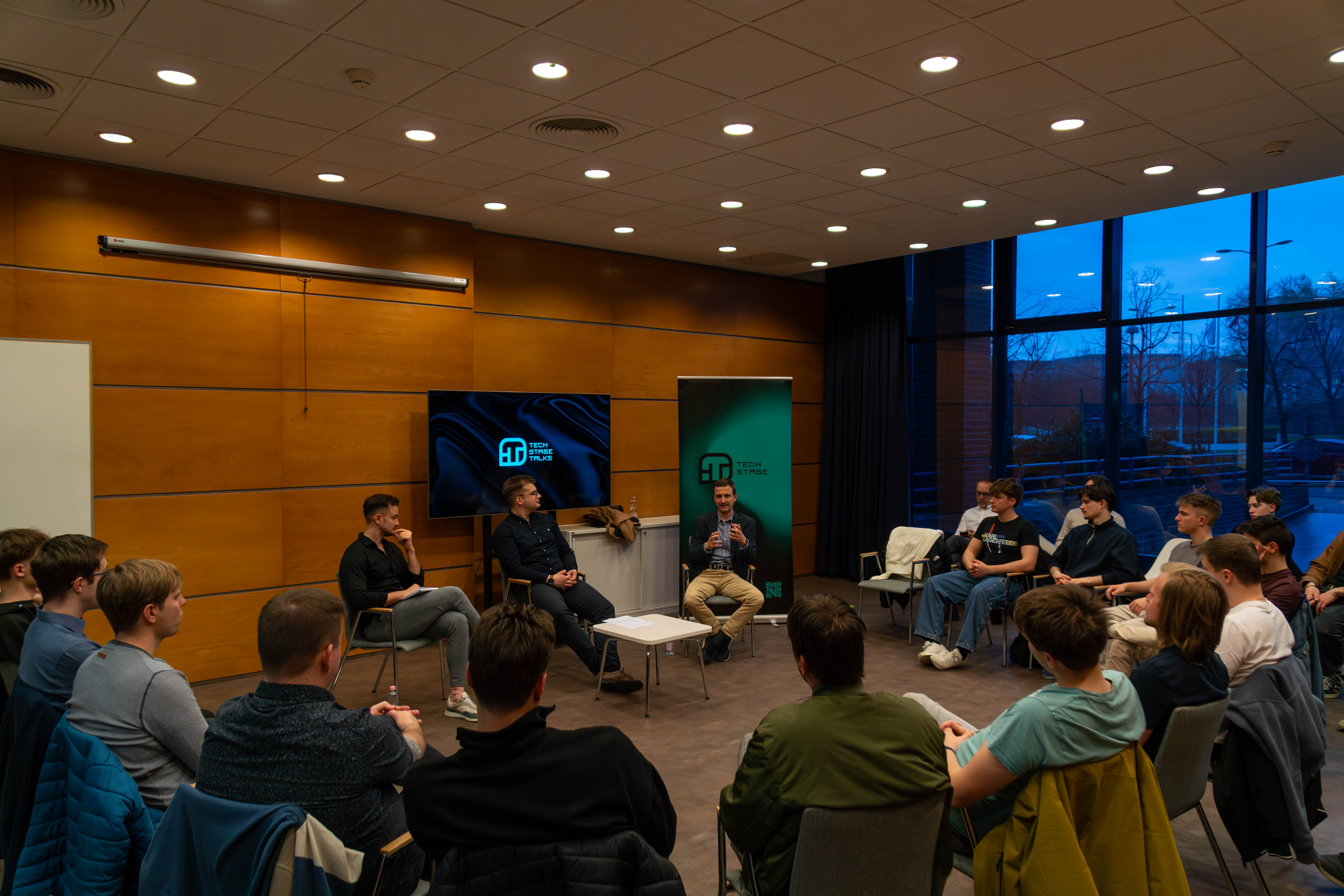
TechStage x BME – AI-Supported Software Engineering
An exclusive TechStage panel at BME explored how AI is transforming software engineering, emphasizing the balance between automation, engineering intuition, and real-world constraints.
TechStage hosted a closed-door panel discussion at BME, bringing together industry professionals and students to explore the evolving role of artificial intelligence in software engineering.
The discussion set out to demystify the hype around AI and establish a shared understanding of what “AI-supported software development” actually means today. Speakers highlighted the current landscape of AI tools, including chat-based systems, agent modules, and IDE integrations such as Cursor, Claude Code, and Windsurf, while also addressing the limitations of AI outputs due to their statistical nature.
A central theme of the panel was the importance of engineering intuition. The speakers emphasized that strong problem-solving skills, hands-on experience, and deep technical understanding remain essential. They discussed whether these intuitions can be developed through AI-assisted workflows or only through traditional learning methods such as debugging, system design, and writing complex code from scratch.
Prompt engineering was identified as an increasingly important skill, but not a substitute for correctly understanding problems. The discussion highlighted that the quality of outcomes depends not only on how prompts are written, but also on the clarity of the underlying problem definition.
The panel also explored how the role of software engineers is evolving. While some argue that the focus is shifting from hard skills to soft skills, the consensus was that technical competencies are not disappearing but rather being redefined. Engineers must learn to effectively collaborate with AI systems while maintaining critical thinking and responsibility for outcomes.
Another key discussion point was where AI delivers the most value today. While it significantly accelerates rapid prototyping and proof-of-concept development, its effectiveness in complex, safety-critical, or enterprise systems remains limited and requires careful human oversight.
The session concluded with practical advice for students: do not rely blindly on AI, stay critical, and avoid choosing the easiest path. True engineering expertise comes from understanding systems deeply and knowing how to act when AI-generated solutions fall short.
The event reinforced a clear message: AI is a powerful tool that enhances software engineering, but it cannot replace human intuition, structured thinking, and real-world experience.